Trace Agent Intent Before It Acts
Problem
It’s hard to know what a planning agent will do until it generates output. This leads to wasted review cycles and unpredictable behavior.
Consequence
Without pre-runtime visibility, reviewers must manually inspect large output blobs without understanding the original step logic or token budget.
Dokugent Solution
Run dokugent plan trace to preview agent steps, linking status, and token estimates.
- See whether steps are included (
linked) - Understand the purpose of each step file
- Anticipate total token usage before execution
Result
Agent behavior becomes transparent and auditable before runtime. Reviewers can approve workflows with higher confidence and less back-and-forth.
Screenshot
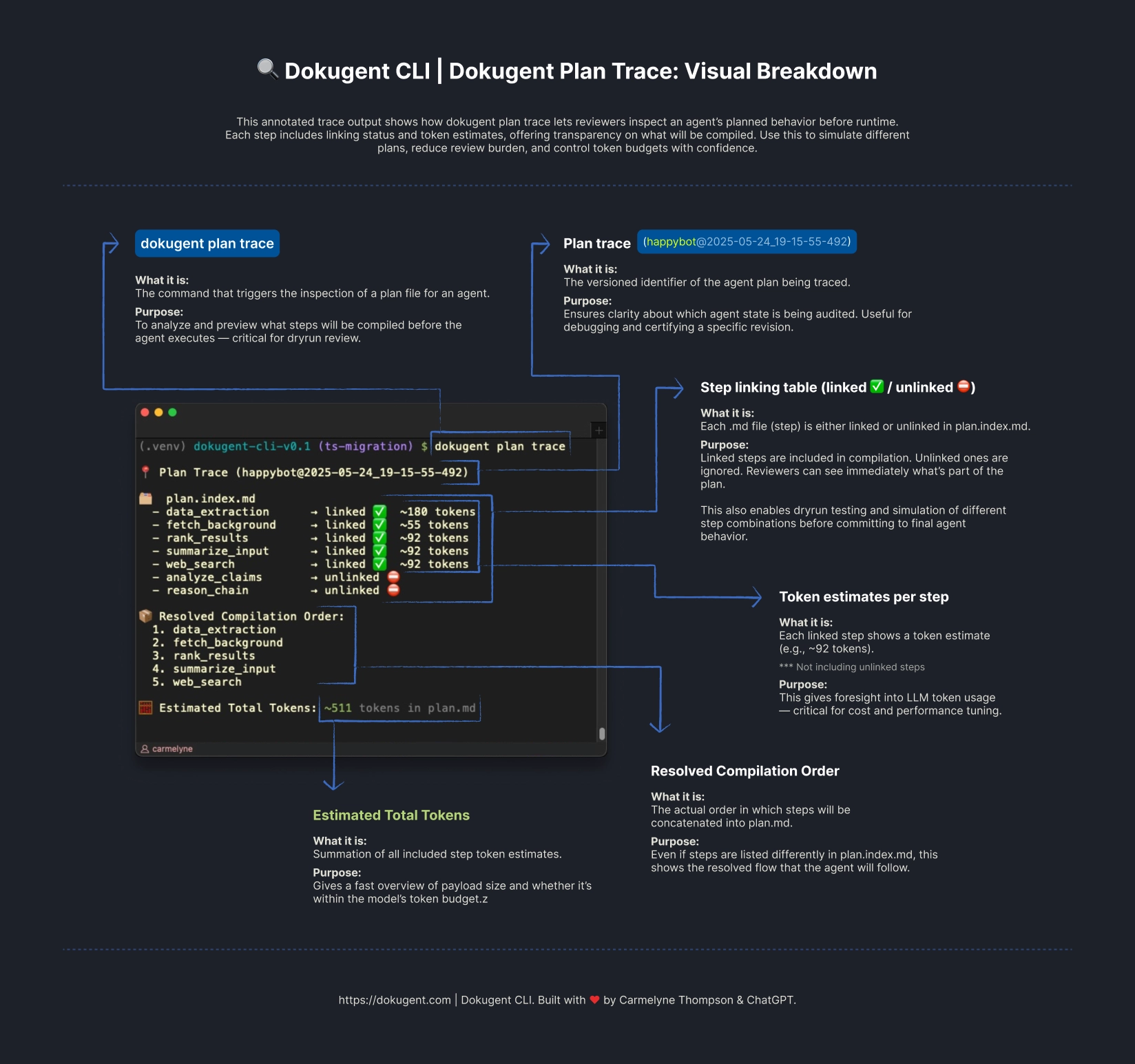
dokugent plan trace showing linked steps, token estimates, and resolved execution order. This visual helps reviewers inspect agent behavior before runtime and estimate token cost. Try It Yourself
LLM Interpretations
Several large language models have correctly interpreted the dokugent plan trace output, demonstrating that the format is both human-readable and LLM-readable — a key requirement for trustable, dryrunnable agent workflows.
🟦 Gemini (Google)
“The
dokugent plan tracecommand is essentially a 'dry run' that gives visibility into the agent's intended behavior before execution. It categorizes each step as linked or unlinked, estimates token usage, and shows the resolved execution order — providing transparency and debugging capabilities before any tokens are consumed.”In larger agent systems, this helps developers detect planning errors, orphaned steps, or overly expensive branches before deployment. It improves clarity while lowering review cost and execution risk.
🟪 Claude (Anthropic)
“The plan trace outlines the modular steps of an agent. It distinguishes linked and unlinked steps and provides token estimates, helping validate the plan before runtime. This offers insight into the agent's intent and resource requirements.”
Because the execution order is resolved before runtime, the agent’s logical path becomes transparent and reviewable — allowing human-in-the-loop approval or automated trust policy enforcement.
These interpretations were generated using raw output from dokugent plan trace, without prompting or editing — confirming cross-model comprehension.